
Types of Digital Marketing
June 22, 2026 2026-06-22 7:59Types of Digital Marketing
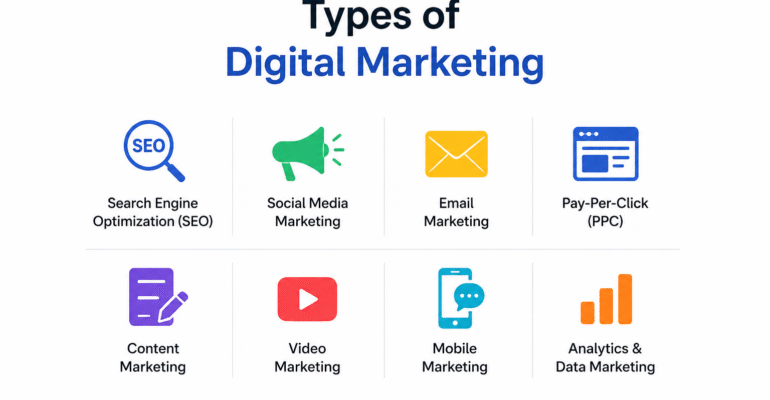
 admin
admin The Ultimate Guide to the Types of Digital Marketing (Without the Overwhelm)
Have you ever stared at your laptop screen, looking at dozens of browser tabs open to different marketing blogs, and felt completely paralyzed?
If so, you are definitely not alone. Between TikTok, Google Ads, SEO, and email campaigns, it feels like there are a million different platforms shouting for your attention and your budget.
Whether you are a small business owner trying to grow your brand, a career switcher trying to learn the ropes, or a traditional marketer transitioning from print and TV, this guide is for you. We are going to break down the main types of digital marketing in plain English, so you can build a strategy that actually works.
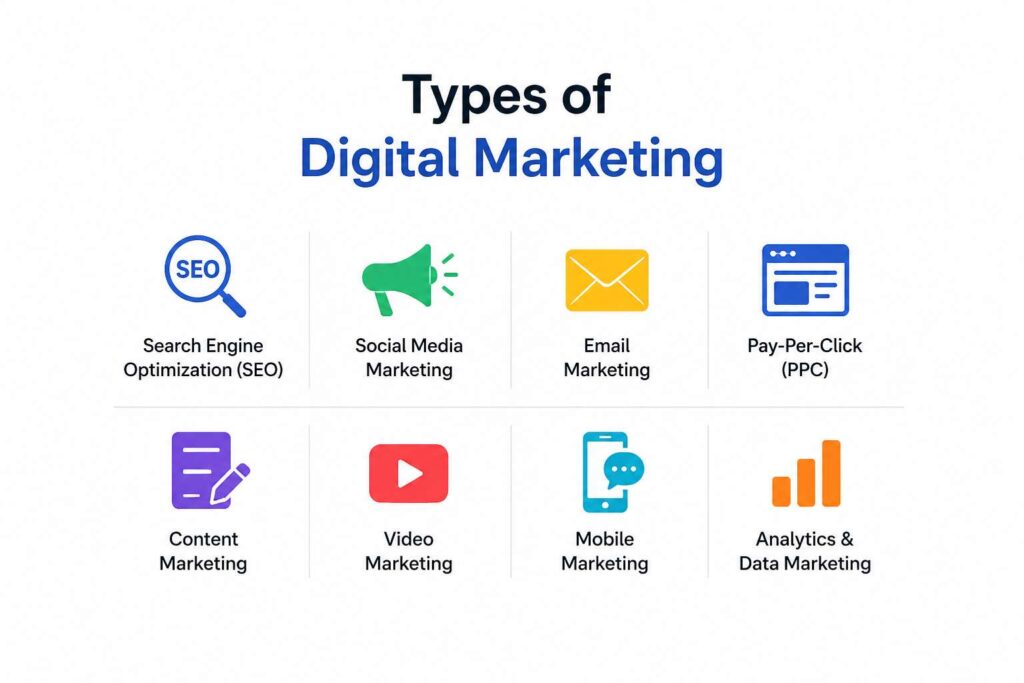
What Exactly is Digital Marketing?
If you come from a traditional marketing background, you already understand the core goal: putting the right message in front of the right person at the right time.
Traditional marketing does this using physical spaces like billboards, paper mailers, or TV commercials. Understanding the different types of digital marketing starts with realizing that this relationship has simply moved online.
At its core, it is any form of marketing that exists online. It is an interconnected ecosystem of different channels working together to build trust, generate leads, and drive sales.
Your Quick-Reference Cheat Sheet (TL;DR)
If you are a busy business owner or student in a rush, here is a quick overview of how the most common types of digital marketing compare.
| Marketing Type | Primary Benefit | Cost Structure | Time to See Results |
|---|---|---|---|
| SEO | Continuous, passive traffic | Low (High time investment) | Long-term (3 to 6 months) |
| Content Marketing | Builds trust and authority | Low to Medium | Medium to Long-term |
| Organic Social | Customer relationship building | Free (Time-heavy) | Medium-term |
| Email Marketing | Highest conversion rate and ROI | Very Low | Fast (to an existing list) |
| PPC (Search Ads) | Instant visibility for buyers | High (Pay-per-click) | Instant (Days) |
| Paid Social | Highly precise audience targeting | Medium to High | Fast (Days) |
| Influencer Marketing | Instant trust and social proof | Medium to High | Fast to Medium |
II. The Core Pillars: Organic Channels (Long-Term Growth)
Organic channels focus on building authority, trust, and lasting value. These organic types of digital marketing do not charge you when someone clicks on your content, making them essential for sustainable, long-term growth.
A. Search Engine Optimization (SEO)
Search Engine Optimization (SEO) is the process of optimizing your website so that search engines like Google rank your pages high up on the search results.
When people search for terms related to your business, you want your website to be the first thing they see. This is done by researching the keywords your audience uses, creating high-quality pages, and getting other reputable websites to link back to yours.
If you are looking for a steady stream of passive, highly interested website visitors, SEO is your best friend.
B. Content Marketing
Content Marketing is all about creating and sharing valuable, free media to attract and keep customers. This includes writing helpful blog posts, filming educational YouTube videos, or designing informative infographics.
Instead of pitching your product directly, you solve your target audience’s real-world problems.
This channel is perfect for brands that want to build deep credibility. It also serves as the fuel for your SEO and social media efforts, giving you valuable resources to share.
C. Organic Social Media Marketing
Organic Social Media Marketing involves building a community and talking with your customers on platforms like Instagram, LinkedIn, TikTok, and Facebook without paying for ads.
To succeed here, you need consistent posting, genuine interactions in the comments, and engaging video content like Reels or TikToks.
It is best used for humanizing your brand and speaking directly to your audience. However, because social media platforms want you to buy ads, organic reach can be limited, meaning it takes dedication to grow.
D. Email Marketing
Email Marketing is sending highly personalized messages directly to a list of subscribers who have given you permission to contact them.
This includes weekly newsletters, automated welcome emails for new sign-ups, and special promotional offers.
Because you own your email list, you do not have to worry about changing social media algorithms. It historically has the highest return on investment of all types of digital marketing because you are speaking directly to warm leads.
III. The Gas Pedals: Paid Channels (Instant Visibility)
Paid channels are like pouring gas on a fire. These paid types of digital marketing focus on buying immediate, highly targeted traffic to your website.
A. Pay-Per-Click Advertising (PPC)
Pay-Per-Click (PPC) advertising means placing ads on search engines like Google where you only pay when someone actually clicks your ad.
You bid on high-intent search terms that people use when they are ready to make a purchase. For example, if you run a plumbing business, you might bid on “emergency plumber near me.”
This is incredibly effective for capturing ready-to-buy customers the exact second they need your services.
B. Paid Social Media Advertising
Paid Social Media Advertising means paying to run targeted campaigns on platforms like Meta, TikTok, or LinkedIn.
Unlike search ads, which target what people search for, social ads target who people are. You can show ads based on demographics, specific interests, or online behaviors.
This is the fastest way to build brand awareness or target a highly specific niche, like “owners of physical therapy clinics in Seattle.”
C. Display & Remarketing Ads
Display Advertising refers to the visual banner ads you see on blogs, news sites, and other third-party websites across the internet.
A subset of this is remarketing, which tracks users who visited your website but did not buy anything, and shows them your ads elsewhere to bring them back.
Remarketing is highly popular because it remains one of the most cost-effective types of digital marketing for rescuing lost sales.
IV. The Accelerators: Relationship & Performance Channels
These relational types of digital marketing leverage third-party trust and existing networks to build your business quickly.
A. Influencer Marketing
Influencer Marketing involves partnering with content creators who already have a dedicated, trusting audience in your niche.
Instead of you telling people how great your product is, an influencer they trust says it for you.
This form of social proof is incredibly powerful for consumer brands looking to show off products visually.
B. Affiliate & Referral Marketing
Affiliate Marketing is a performance-based system where you pay a commission to external partners who send paying customers to your website.
Because you only pay when an actual sale is made, it is an incredibly low-risk marketing strategy.
This model is highly popular for e-commerce stores, online courses, and software companies.
V. Strategic Matchmaking: How to Choose Your Channels
You do not need to master all types of digital marketing at once. To avoid analysis paralysis, use these simple frameworks to pick your starting point.
The “Time vs. Money” Matrix
Balancing these different types of digital marketing often comes down to your immediate resources:
- If you have time, but no budget: Double down on organic channels. Start with Content Marketing, SEO, and Organic Social to build your foundation.
- If you have budget, but no time: Lean heavily into paid channels. Use PPC and Paid Social to generate leads and sales immediately.
The B2B vs. B2C Playbooks
- The B2B (Business-to-Business) Playbook: If you sell to other businesses, focus on high-trust, educational channels. Your primary focus should be LinkedIn, SEO, and Email Marketing.
- The B2C (Business-to-Consumer) Playbook: If you sell directly to consumers, focus on visual, emotional, and instant-purchase channels. Your primary focus should be Instagram/TikTok, Influencer Marketing, and Email Marketing.
VI. Measuring Success (KPIs Explained)
For traditional marketers learning new types of digital marketing, the biggest benefit of online marketing is that everything can be tracked. Here are the two most important formulas you need to know.
1. Conversion Rate ($CR$)
Your Conversion Rate tells you what percentage of your website traffic actually takes a desired action, like signing up for a newsletter or buying a product.$$CR = \left( \frac{\text{Total Conversions}}{\text{Total Visitors}} \right) \times 100$$
2. Return on Ad Spend ($ROAS$)
If you run paid ads, Return on Ad Spend measures whether your campaigns are profitable.$$ROAS = \frac{\text{Total Revenue Generated from Ads}}{\text{Total Cost of Ads}}$$
VII. Common Pitfalls to Avoid
As you begin launching these types of digital marketing, keep these three golden rules in mind:
Conclusion & Next Steps
These types of digital marketing are not isolated strategies that you turn on and off. Instead, they form an ecosystem of interconnected channels that work together to guide someone from a stranger to a loyal customer.
Start small, focus on your audience’s needs, and expand your channels as you grow.