
Best Digital Marketing Strategy Framework
July 14, 2026 2026-07-14 6:02Best Digital Marketing Strategy Framework
Best Digital Marketing Strategy Framework
 admin
admin No More Random Acts of Marketing: The Ultimate Digital Marketing Strategy Framework
Have you ever felt like you are playing a relentless game of “tactical whack-a-mole”?
One day you are scrambling to post on Instagram, the next you are trying to understand SEO, and by Friday you are throwing money at a random Facebook ad. You are working incredibly hard, but it feels like you are getting nowhere.
If this sounds familiar, you do not have an effort problem—you have a framework problem.
- If you are an overwhelmed founder: You have ten hats to wear today, and marketing should not feel like playing the lottery.
- If you are a solo marketer: You are tired of guessing what works and struggling to prove your actual value to your boss.
- If you are an agency pro: You need a repeatable, professional system that builds instant authority during client pitches.
This guide is a repeatable, 4-stage digital marketing strategy framework to help you map out your efforts. It is not a rigid, academic rulebook that requires a million-dollar budget.
A successful marketing framework does not predict the future. Instead, it provides a structured blueprint to test, measure, and scale what actually works.
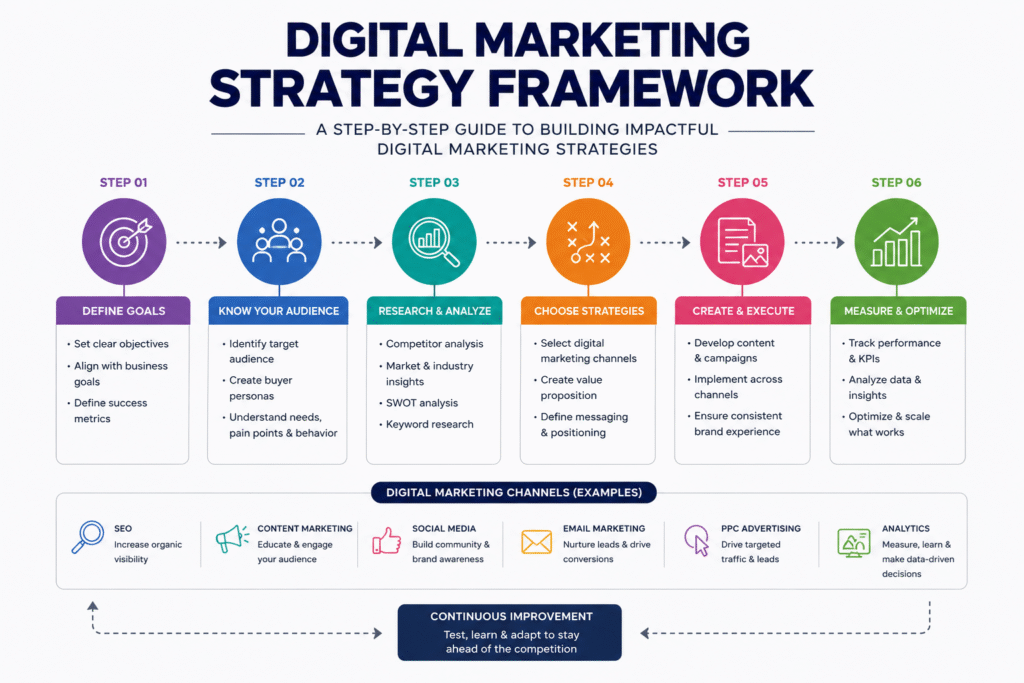
The Core Terminology: Disentangling the “Three Kings”
Before we dive into building your digital marketing strategy framework, let us clear up some common industry confusion. People often throw around terms like “framework,” “strategy,” and “campaign” as if they mean the same thing. They do not.
- The Framework (The Skeleton): This is the structured, repeatable process you use to build your marketing plans.
- The Strategy (The Muscle): This is your unique angle, including your target audience, positioning, and the channels you choose to hit specific business goals.
- The Campaign (The Movement): These are short-term, highly tactical executions, such as a Black Friday email sequence.
You cannot build a successful marketing strategy or execute a great campaign without a solid digital marketing strategy framework supporting them.
The Industry Standards: A 2-Minute Crash Course
If you search for a digital marketing strategy framework online, you will likely run into two massive industry giants. Knowing them will help solo marketers speak confidently to executives and help agency pros pitch clients.
- The RACE Framework: Created by Smart Insights, this stands for Reach, Act, Convert, and Engage. It is brilliant for e-commerce and SaaS brands focused heavily on digital conversion funnels.
- The SOSTAC® Model: Created by PR Smith, this stands for Situation, Objectives, Strategy, Tactics, Action, and Control. It is highly structured and works best for corporate planning.
Because these models can sometimes feel overly academic for lean teams, we developed a simplified, hybrid model: the A.C.E.S. Framework.
Deep-Dive: The A.C.E.S. Digital Marketing Strategy Framework
The A.C.E.S. digital marketing strategy framework is built specifically for lean teams who need to get maximum results with limited resources.
[Analyze] ➔ [Clarify] ➔ [Execute] ➔ [Scale & Optimize]
Step 1: Analyze (Where are we now?)
Before looking forward, you must uncover the baseline truth of your business, audience, and competitors.
- The Digital Audit: Catalog your existing assets, including your current website traffic, email list size, and social media reach.
- The Competitor Benchmark: Ethically spy on competitors using free tools like SimilarWeb or the Facebook Ad Library.
- The Buyer Persona Map: Define who your ideal customers are, their primary pain points, and where they hang out online.
- Founder Tip: Do not build five different personas; focus on just one ideal customer profile (ICP) to keep your resources tight.
- Agency Tip: Package this step as a paid “Discovery Phase” to bill clients before committing to long-term execution.
Step 2: Clarify (Where do we want to go?)
Next, define your unique online value and set crystal-clear goals.
- The Digital Value Proposition (DVP): Answer honestly why a customer should buy from you online instead of your competitor.
- SMART Objectives: Turn vague goals like “I want more sales” into “Increase website conversion rates by 15% in Q3.”
- KPI Mapping: KPI mapping is a vital part of any digital marketing strategy framework because it tracks the right metrics at each stage of the customer journey:
| Funnel Stage | Focus Area | Key Metric to Track |
|---|---|---|
| Top of Funnel | Awareness | Website Impressions & Clicks |
| Middle of Funnel | Consideration | Email Opt-ins & Lead Quality |
| Bottom of Funnel | Conversion | Customer Acquisition Cost (CAC) & Conversion Rate |
Step 3: Execute (How do we get there?)
Execution is where your digital marketing strategy framework comes to life through active channels.
- The “Less is More” Strategy: Do not try to be on TikTok, LinkedIn, SEO, and Meta Ads all at once. Choose just one or two channels where your target audience is most active.
- The 3-Tier Funnel:
- Attract: Bring people in using SEO, Content Marketing, or paid ads.
- Nurture: Build relationships through regular email marketing.
- Convert: Turn subscribers into buyers using highly optimized landing pages.
Step 4: Scale & Optimize (Are we getting there?)
Finally, build a systematic feedback loop to cut losing tactics and double down on winners.
- The 30-Day Performance Audit: Review your data monthly, ignoring vanity metrics (like social media likes) in favor of business metrics (like leads and sales).
- The ICE Prioritization Framework: Rate new ideas based on Impact, Confidence, and Ease to decide what to build next.
- Solo Marketer Tip: Use these metrics to build a clean, simple monthly dashboard to show your boss exactly how marketing drives revenue.
The Lean Team’s Guide to Resource & Budget Allocation
A complete digital marketing strategy framework must address resource and budget allocation for small teams. We recommend the 70-20-10 budgeting rule:
- 70% of your budget: Spend this on safe, proven channels that consistently bring in leads.
- 20% of your budget: Invest this in high-potential, emerging channels you want to optimize.
- 10% of your budget: Set this aside for high-risk, experimental marketing ideas.
To keep costs low, build a simple lean tech stack using affordable tools like Google Analytics 4 for tracking, Canva for design, Notion for planning, and MailerLite for emails.
https://youtu.be/F4YuptMRMBY?si=A3h047infGL6DxoL
Ready to Build Your Own Strategy?
A great digital marketing strategy framework is meant to relieve pressure, not create more work. It is a powerful tool designed to help you confidently say “no” to marketing distractions.
Download our free, interactive 1-Page Digital Marketing Strategy Framework Notion Template today to map out your entire strategy on a single sheet!