
Traditional Marketing vs. Digital Marketing: The Definitive Strategy Guide
July 30, 2026 2026-07-30 8:25Traditional Marketing vs. Digital Marketing: The Definitive Strategy Guide
Traditional Marketing vs. Digital Marketing: The Definitive Strategy Guide
 admin
admin Introduction
Imagine passing a massive billboard on your morning commute promoting a local coffee shop. Later that afternoon, while scrolling through Instagram, you see an ad for that exact shop offering 20% off your first order.
Which ad gets you through the door? More importantly, which gave the shop owner a better return on their money?
When evaluating traditional marketing vs digital marketing, business leaders face this decision every day. The debate over traditional marketing vs digital marketing can feel overwhelming, but here is the secret experienced marketers know: it is rarely an “either/or” choice.
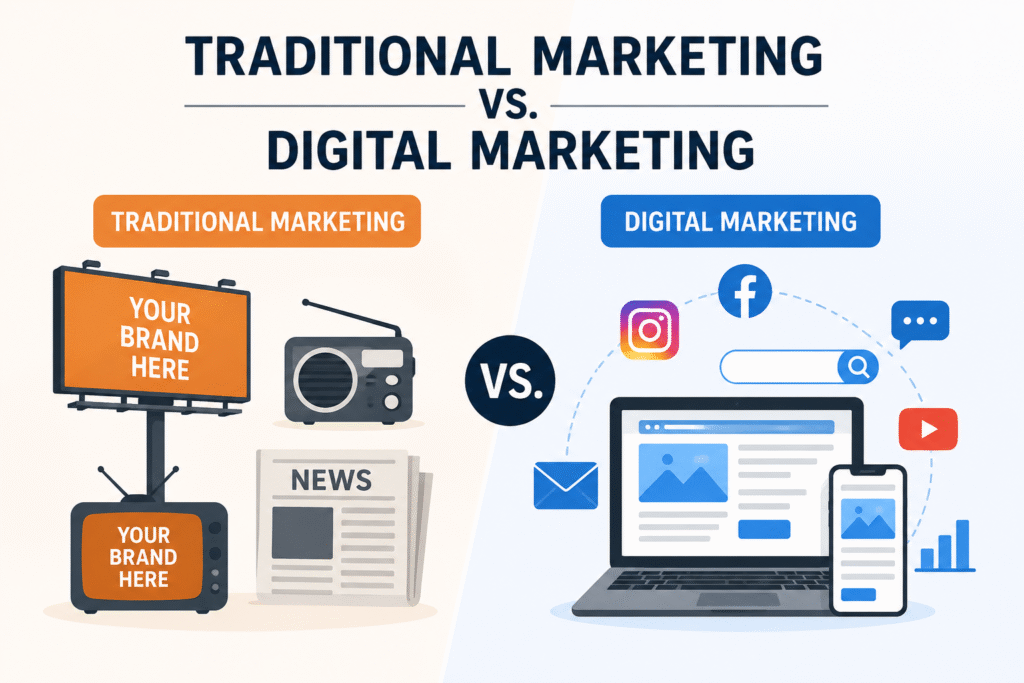
1. Core Differences Defined
To choose the right path, we must look at how these channels function.
- Traditional Marketing: Offline promotional methods aimed at reaching a broad audience through broadcast and physical media. Channels include print ads, TV, radio spots, billboards, and direct mail.
- Digital Marketing: Online promotional efforts relying on data, web connectivity, and targeted interactions. Channels include Search Engine Optimization (SEO), Pay-Per-Click (PPC) ads, social media, and email campaigns.
The ultimate distinction in traditional marketing vs digital marketing comes down to interaction. Traditional channels act as a one-way broadcast. Digital channels function as a two-way conversation, letting you engage directly with prospective buyers.
2. Head-to-Head Comparison
| Feature | Traditional Marketing | Digital Marketing |
| Primary Goal | Broad Brand Awareness & Trust | Targeted Conversions & Lead Gen |
| Targeting | Demographics & Geography | Behavior, Search Intent & Micro-demographics |
| Entry Cost | High (Requires upfront capital) | Low (Start with $5–$10/day) |
| Speed of Results | Slow to Medium | Immediate (PPC) to Long-term (SEO) |
| Tracking | Indirect / Estimated | Direct & Exact (Analytics, pixels, ROAS) |
| Engagement | Static / One-way | Interactive / Two-way |
3. Deep Dive into Traditional Marketing
Offline advertising remains remarkably effective for specific industries and demographics.
Where Traditional Excels
- Local Foot Traffic: Direct mail and flyers remain ideal for neighborhood services like plumbers, realtors, and restaurants.
- Tangible Trust: High-end magazines, TV spots, and billboards carry prestige that builds immediate consumer trust.
- Older Demographics: Physical mailers perform significantly better with audiences over age 60.
The Limitations
- High Upfront Costs: Buying billboard space or print runs requires capital before making a single sale.
- Difficult Attribution: Proving how many sales came from a specific billboard is notoriously tough.
- No Edits: You cannot tweak print ads or fix typos after launch without paying for a full reprint.
4. Deep Dive into Digital Marketing
Digital channels give small startups access to the same tools used by global enterprises.
Where Digital Excels
- Laser-Focused Targeting: Show ads exclusively to people actively searching for your specific service.
- Budget Flexibility: Launch test campaigns with $5 a day and scale spend as revenue grows.
- Granular Measurement: Track click-through rates (CTR), cost per acquisition (CPA), and return on ad spend (ROAS) down to the dollar.
The Limitations
- Steep Learning Curve: Managing ad platforms, tracking pixels, and algorithms requires regular practice.
- Ad Fatigue & Competition: High ad saturation leads to consumer “banner blindness” and rising cost-per-click (CPC) rates.
5. Cost & ROI Breakdown
Understanding the financial side of traditional marketing vs digital marketing helps you make smarter decisions.
A decent billboard spot or radio campaign can easily cost $1,000 to $5,000 per month just to secure placement. By contrast, digital marketing lets you set flexible daily budgets. A small business can spend $150 a month testing hyper-targeted Google Search campaigns and adjust immediately based on performance.
When examining traditional marketing vs digital marketing, consider your Customer Acquisition Cost (CAC). Digital usually yields a lower CAC for online businesses. However, for high-ticket local services, a single targeted postcard campaign can yield a lower CAC than competitive online search keywords.
https://youtu.be/skDviaYcP1o?si=u6M1vuvHULDTQAmx
6. The “Hybrid Strategy” (Phygital Marketing)
The most successful brands combine both approaches to bridge offline engagement with online tracking:
- Dynamic QR Codes: Place distinct QR codes on flyers or print ads to direct users to custom landing pages.
- Call-Tracking Numbers: Print unique phone numbers on direct mailers to track offline lead sources automatically.
- Cross-Channel Campaigns: Pair local radio or TV spots with social media hashtag contests to drive online search volume.
When splitting budgets in traditional marketing vs digital marketing:
- Startups & SMBs: 80–90% Digital / 10–20% Traditional.
- Mid-Market Companies: 60% Digital / 40% Traditional.
- Enterprise Brands: 50% Digital / 50% Traditional.
7. Self-Assessment: Which Should You Choose?
When deciding on traditional marketing vs digital marketing, ask four key questions:
- Who is your buyer? Tech-savvy audiences require digital channels; seniors or localized neighborhoods respond better to print.
- What is your budget? Under $1,000 per month favors digital testing. Larger budgets allow for broad traditional exposure.
- What is your geographic scope? E-commerce brands need digital; local repair shops benefit from local SEO combined with direct mail.
- What is your timeline? Immediate leads require digital PPC. Decadelong brand-building favors a broad mix of both.
Final Thoughts
When comparing traditional marketing vs digital marketing, remember that you do not have to pick a side permanently. Traditional channels build broad presence and high trust, while digital channels provide precision, tracking, and agility. Build a strong digital foundation first, then layer in traditional tactics as your budget scales.