
Digital Marketing for Beginners: Learn, Grow, Succeed
June 18, 2026 2026-06-22 7:57Digital Marketing for Beginners: Learn, Grow, Succeed
Digital Marketing for Beginners: Learn, Grow, Succeed
 admin
admin Table of Contents
The Ultimate Guide to Digital Marketing for Beginners
Does the thought of online marketing make your head spin?
Between SEO, PPC, CTR, ROI, and trying to figure out if you should be on TikTok or Threads, the overwhelm is completely normal.
Here is the good news: you do not need a million-dollar budget or a computer science degree to succeed with digital marketing for beginners.
At its simplest, digital marketing is just connecting with your target audience in the right place, at the right time. Today, that place is online.
To help you get the most out of this guide on digital marketing for beginners, choose the journey below that matches your current situation:
- The Bootstrapping Entrepreneur: You need immediate, high-ROI, low-to-no-cost strategies to grow your small business.
- The Career Switcher: You are a student or professional seeking CV-boosting credentials, practical skills, and a real-world portfolio.
- The Traditional Marketer: You want to translate your existing print, TV, or billboard skills to online channels without feeling left behind.
Part 1: The Core Mindset Shift
Traditional vs. Digital Marketing
Traditional marketing relies on interruption. This is “push” marketing, like disrupting someone’s favorite TV show with a commercial or placing a billboard on their commute.
Digital marketing is built on attraction. This is “pull” marketing, where you appear online at the exact moment a customer is actively searching for a solution.
When you transition online, you unlock four massive superpowers:
- Hyper-Targeting: You can show ads exclusively to people of a specific age, interest, or search intent.
- Two-Way Communication: You can chat, reply, and build relationships with customers in real-time.
- Real-Time Agility: You can edit an online ad creative in five seconds instead of waiting weeks for a billboard print.
- Traceable Attribution: You can track exactly which click or video led directly to a sale.
The “T-Shaped” Marketer Framework
Trying to master every marketing channel at once is a recipe for burnout. A core framework in digital marketing for beginners is becoming a T-shaped marketer.
      THE HORIZONTAL BAR: Broad Competency (SEO, Email, Ads, Social)
      =============================================================

         ||  THE VERTICAL BAR:
         ||  Deep Specialization
        ||  (e.g., Email Marketing)
The horizontal bar represents broad competency, meaning you understand how all channels work together. The vertical bar represents deep specialization, where you choose just one specific channel to master first.
Part 2: The 5 Core Pillars of Digital Marketing for Beginners
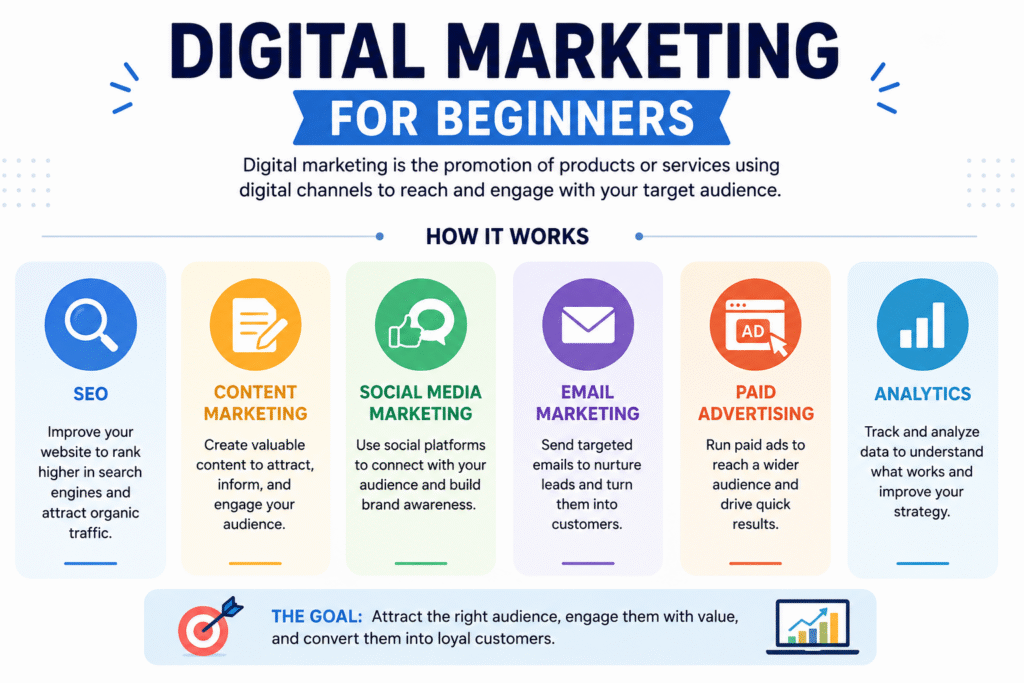
Pillar 1: Search Engine Optimization (SEO)
SEO is the art of earning free, passive traffic from search engines like Google by being the best answer to a user’s question. Understanding search engines is one of the most powerful steps in digital marketing for beginners.
To succeed, you must balance the three legs of the SEO stool:
- On-Page SEO: Writing helpful content and organizing your page with relevant keywords.
- Off-Page SEO: Earning trust and backlinks (votes of confidence) from other reputable websites.
- Technical SEO: Ensuring search engines can easily find, crawl, and load your website quickly.
- Small Business Tip: Claim and optimize your free Google Business Profile to win local search traffic.
- Career Switcher Tip: Practice finding search terms with free tools like Google Keyword Planner or AnswerThePublic.
- Traditional Marketer Tip: View keyword research as digital focus groups that reveal exactly what your customers want.
Pillar 2: Content Marketing
Content marketing is creating and sharing free, valuable assets like blogs, videos, or templates to turn strangers into loyal customers. When looking at digital marketing for beginners, content is the fuel that runs every other channel.
The golden rule is “give to get.” Share 80% of your knowledge for free to build trust, authority, and reciprocity.
Keep your content aligned with the simplified marketing funnel:
- Top of Funnel (Awareness): Blog posts or videos answering basic industry questions.
- Middle of Funnel (Consideration): Free templates, comparison guides, or checklists.
- Bottom of Funnel (Decision): Case studies, product demos, and client testimonials.
- Small Business Tip: Record simple videos answering the top ten questions your clients ask you.
- Career Switcher Tip: Write three analytical LinkedIn posts per week breaking down successful marketing campaigns to build authority.
- Traditional Marketer Tip: Use your copywriting strengths to transition from billboard slogans to high-converting blog titles.
Pillar 3: Social Media Marketing (SMM)
Social media is about building community and humanizing your brand where your audience hangs out. An essential rule in digital marketing for beginners is to avoid the platform trap of trying to be active everywhere at once.
If you sell to other businesses (B2B), focus on LinkedIn; if you are highly visual or e-commerce, prioritize Instagram or TikTok. Remember that organic reach has declined, so building genuine engagement matters far more than your total follower count.
- Small Business Tip: Pick just one platform where your best buyers hang out and master it completely.
- Career Switcher Tip: Manage a social account for a local charity or passion project to build a proven portfolio.
- Traditional Marketer Tip: Treat social media as a real-time public relations and customer service tool, not a billboard.
Pillar 4: Paid Advertising (PPC)
PPC stands for Pay-Per-Click, where you buy instant, highly-targeted traffic to your website. While ads are fast, a safe approach to digital marketing for beginners is setting strict daily limits of $5 to $10.
The industry is dominated by two giants:
- Google Ads: Intent-based search ads that catch people when they are actively looking to buy.
- Meta Ads: Interest-based social ads that interrupt users with relevant visuals based on what they like.
- Small Business Tip: Target only highly specific buyer terms in your local area to avoid wasted ad spend.
- Career Switcher Tip: Take the free Google Ads and Meta Blueprint certification courses to bypass resume filters.
- Traditional Marketer Tip: Map your media buying and reach principles directly to digital bid strategies.
Pillar 5: Email Marketing
Email marketing is your direct line of communication with your audience, completely safe from social media algorithm changes. If you only build one asset while studying digital marketing for beginners, make it an email list.
A basic email funnel consists of:
- The Opt-In Offer (Lead Magnet): A free checklist, guide, or discount code.
- The Landing Page: A simple webpage built to collect email addresses in exchange for the offer.
- The Welcome Automation: An automated 3-part email sequence welcoming them and delivering value.
- Small Business Tip: Start building your list on day one; 500 warm subscribers are worth more than 10,000 cold followers.
- Career Switcher Tip: Learn how to design simple automations using free accounts on Mailchimp or ConvertKit.
- Traditional Marketer Tip: Think of email as highly targeted, personalized, and interactive direct mail.
Part 3: Data & Metrics (Measuring What Matters)
Do not get distracted by vanity metrics like likes, pageviews, or follower counts. Data is the backbone of digital marketing for beginners, so focus on actionable metrics instead.
We recommend tracking Click-Through Rate (CTR), Conversion Rate (CVR), and Cost Per Acquisition (CPA). To check if your marketing is truly profitable, use the standard Return on Investment (ROI) formula:$$\text{ROI} = \left( \frac{\text{Financial Return} – \text{Total Marketing Cost}}{\text{Total Marketing Cost}} \right) \times 100\%$$
To track this data, use a free starter tech stack: Google Analytics 4 to see what people do on your site, Google Search Console to see how they find you, and Hotjar to see where they click.
Part 4: Your 30-Day Action Blueprints
To help you put this knowledge into practice, here are three tailored action plans designed for digital marketing for beginners.
Track A: The Small Business Owner
- Days 1–10: Set up and verify your Google Business Profile, then ask 5 past clients for reviews.
- Days 11–20: Install Google Analytics 4 and build a simple landing page with a clear contact button.
- Days 21–30: Create a simple lead magnet, start collecting emails, and send your first newsletter.
Track B: The Career Switcher
- Days 1–10: Complete free marketing certifications on HubSpot Academy and Google Skillshop.
- Days 11–20: Launch a basic “sandbox” website about a personal hobby and write three SEO-optimized posts.
- Days 21–30: Create a brief case study document detailing your site’s setup and traffic data to use as your portfolio.
https://youtu.be/CBUF5V4iNgU?si=e7pmY1aUS5WwLi_2
Track C: The Traditional Marketer
- Days 1–10: Learn how digital attribution models work to track online customer journeys.
- Days 11–20: Master digital copywriting formulas like AIDA (Attention, Interest, Desire, Action).
- Days 21–30: Shadow a digital colleague or set up a small trial search campaign to learn the ad interfaces.
The Next Step
Digital marketing is a hands-on, test-and-learn discipline. Nobody gets it perfectly right on their first try, and that is completely fine!
Remember, the secret to mastering digital marketing for beginners is consistent action over perfect planning.
What is your next move? Leave a comment below with the one channel you plan to master first, or download our free, comprehensive Digital Marketing Beginner Checklist to start tracking your progress today.