
SEO Digital Marketing : Step-by-Step Beginner’s Guide
September 1, 2026 2026-09-01 5:49SEO Digital Marketing : Step-by-Step Beginner’s Guide
SEO Digital Marketing : Step-by-Step Beginner’s Guide
 admin
admin Master SEO digital marketing with our easy step-by-step guide. Learn how search works, the 3 core pillars, and how to drive organic leads without paid ads.
If you have ever felt like digital advertising prices keep climbing while your marketing budget stays the same, you are not alone.
Running paid ads can yield quick wins, but the moment you stop paying, the traffic stops instantly.
That is where SEO digital marketing comes in. By optimizing your website for organic search, you build a reliable lead engine that continues driving customers to your business long after you publish your content.
In this guide, we will break down SEO digital marketing into simple, clear concepts so you can grow your online presence with confidence.
What You Will Learn in This Guide:
- The Foundations: How SEO fits into the broader digital marketing landscape.
- How Search Works: Crawling, indexing, and ranking explained without complex jargon.
- The 3 Pillars: On-page, off-page, and technical SEO made simple.
- Channel Comparisons: SEO vs. PPC and Social Media Marketing.
- Actionable Roadmap: A step-by-step plan to optimize your website today.
- ROI & Timelines: Realistic expectations for traffic growth, costs, and key metrics.
- Future Trends: How AI search and E-E-A-T shape modern optimization.
II. Demystifying the Role of SEO in Digital Marketing
To understand SEO digital marketing, it helps to think of Search Engine Optimization (SEO) as the steady backbone of your entire online strategy.
Traditional advertising uses push marketing, where you interrupt people with billboards or feed ads. SEO relies on pull marketing, meeting potential customers at the exact moment they are searching for a solution.
       +-------------------------------------------------------+
       |               SEO (Search Engine Optimization)        |
       |       Captures active search intent & drives traffic  |
       +---------------------------+---------------------------+
                                   |
         +-------------------------+-------------------------+
         |                         |                         |
         v                         v                         v
+------------------+     +-------------------+     +-------------------+
| Content Strategy |     | Social Channels   |     | Paid Ads / PPC    |
| Educates & converts|   | Amplifies reach   |     | Shares target data|
+------------------+     +-------------------+     +-------------------+
SEO works hand-in-hand with every other marketing channel:
- Content Marketing: SEO tells you what topics your audience wants, bringing steady traffic to your blog posts and guides.
- Social Media: Great content optimized for search gives you high-value material to share across social platforms.
- Paid Search (PPC): Keyword research for SEO directly improves your paid ad targeting and reduces customer acquisition costs.
- Conversion Rate Optimization (CRO): SEO brings high-intent visitors to your site, making it easier to turn readers into paying customers.
Think of paid advertising like a light switch: when you turn off the cash flow, the lights go out. SEO is more like an annuity or compounding investment, building authority over time to deliver long-term returns.
III. How Search Engines Work (In Simple Terms)
Search engines like Google want to deliver the best answer to a user’s query as quickly as possible. To do that, they follow a basic three-step process:
- Crawling: Search engines send out automated bots (often called spiders) to discover new and updated pages on the web.
- Indexing: The search engine analyzes the content, images, and structure of those pages, storing them in a massive digital library.
- Ranking: When a user types in a query, the algorithm scans its index to display the most relevant, trustworthy results.
Here is the secret most people miss: You are not optimizing for a cold algorithm; you are optimizing for human search intent.
When you solve a real person’s problem better than anyone else, search engines naturally reward your content with higher positions.
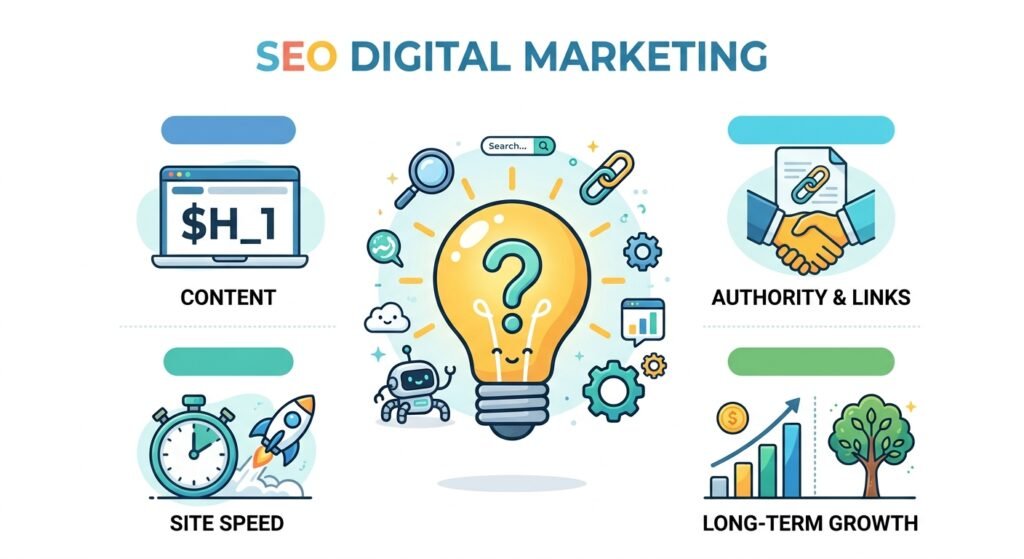
IV. The 3 Core Pillars of SEO (The Foundational Framework)
Every successful SEO digital marketing strategy rests on three primary pillars. Let’s break them down into practical pieces.
                  +-----------------------------------+
                  |      The 3 Pillars of SEO         |
                  +-----------------+-----------------+
                                    |
     +------------------------------+------------------------------+
     |                              |                              |
     v                              v                              v
+-----------------------+  +-----------------------+  +-----------------------+
|    1. On-Page SEO     |  |    2. Off-Page SEO    |  |    3. Technical SEO   |
| Content & Relevance   |  |   Authority & Trust   |  | Infrastructure & Speed|
+-----------------------+  +-----------------------+  +-----------------------+
Pillar 1: On-Page SEO (Content & Relevance)
On-page SEO involves everything you create directly on your website pages to help users and search engines understand your topic.
- Target Keyword Placement: Place your main topic phrase in your title tag, meta description, primary headings ($H_1, H_2$), and early body paragraphs.
- Intent Matching: Make sure your content delivers what the searcher expects—whether that is a quick definition, a step-by-step tutorial, or a product page.
- User Experience & Readability: Format your text with bullet points, subheadings, bold highlights, and clear visual layout to keep readers engaged.
Pillar 2: Off-Page SEO (Authority & Trust)
Off-page SEO focuses on building your site’s reputation across the wider internet.
- Backlinks as Votes: When another reputable site links to your content, search engines view it as a endorsement of your credibility.
- Quality Over Quantity: A single link from a well-known industry publication carries far more value than dozens of links from obscure directory sites.
- Digital PR & Outreach: Share valuable insights with industry blogs, podcasts, and news outlets to naturally earn mentions and authority links.
Pillar 3: Technical SEO (Crawlability & Infrastructure)
Technical SEO ensures that search engine bots can easily access, read, and index your website without hiccups.
- Page Speed: Fast-loading pages reduce user frustration and help improve your search positions.
- Mobile-First Indexing: Google primarily uses the mobile version of your website to evaluate rankings, so a clean mobile design is essential.
- Site Architecture: Organize your web pages logically with intuitive menus and clear internal links so search bots can find every page easily.
V. Strategic Channel Comparisons: Where Should You Spend Your Time & Money?
Choosing where to invest your marketing bandwidth can feel overwhelming. Let’s look at how SEO compares to other channels.
1. SEO vs. PPC (Pay-Per-Click Advertising)
| Strategy Aspect | SEO (Search Engine Optimization) | PPC (Pay-Per-Click Ads) |
|---|---|---|
| Cost Structure | High upfront effort/time, low ongoing cost per visitor | Pay for every single click |
| Speed to Results | 3 to 12 months for steady traction | Immediate traffic once ads launch |
| Trust Level | High (users often bypass sponsored ads) | Moderate (clearly labeled as ads) |
| Long-Term ROI | Compounding value over time | Stops immediately when budget ends |
- When to use PPC: For immediate product launches, limited-time promotions, or high-competition transactional keywords.
- When to use SEO: For long-term growth, building brand authority, and lowering customer acquisition costs.
- The Hybrid Approach: Run targeted PPC campaigns for immediate leads while building out your organic SEO foundation for sustainable long-term traffic.
2. SEO vs. Social Media Marketing
Social media relies on interruption discovery, pushing posts into feeds while users browse passively. SEO focuses on active intent, answering questions for users actively searching for answers right now.
Additionally, social media posts often lose visibility within hours or days. A well-optimized SEO article can drive qualified leads for months or even years.
VI. Actionable Step-by-Step SEO Implementation Roadmap
Ready to get started? Follow this beginner-friendly roadmap to optimize your content.
+-------------------------------------------------------------------------+
| STEP 1: Beginner Keyword Research                                       |
| Find low-competition, high-intent phrases using free or paid tools.    |
+------------------------------------+------------------------------------+
                                     |
                                     v
+-------------------------------------------------------------------------+
| STEP 2: Create High-Value Content                                       |
| Write comprehensive answers structured with clear $H_1, H_2, H_3$ headings. |
+------------------------------------+------------------------------------+
                                     |
                                     v
+-------------------------------------------------------------------------+
| STEP 3: Complete On-Page Checklist                                      |
| Optimize title tags, URLs, meta descriptions, image ALT text, and links.|
+------------------------------------+------------------------------------+
                                     |
                                     v
+-------------------------------------------------------------------------+
| STEP 4: Build Initial Backlinks                                         |
| Leverage existing business contacts and unlinked brand mentions.        |
+-------------------------------------------------------------------------+
Step 1: Beginner-Friendly Keyword Research
Target keywords that reflect real customer problems without competing against massive global brands right away.
- Use tools like Google Keyword Planner, Google Search Console, AnswerThePublic, or Semrush.
- Look for phrases with reasonable search volume and lower keyword difficulty scores.
Step 2: Content Creation & Topical Authority
Focus on creating the single best answer available for your target topic.
- Organize your post logically using hierarchical headers ($H_1$ for main title, $H_2$ for main sections, $H_3$ for subsections).
- Answer common follow-up questions directly inside your content.
Step 3: On-Page Optimization Checklist
- [ ] Include your primary keyword in the $H_1$ title, URL, and first 100 words.
- [ ] Write an engaging Meta Description that encourages users to click.
- [ ] Add descriptive ALT text to every image for accessibility and image search indexing.
- [ ] Add 3 to 5 internal links pointing to related guides on your site.
Step 4: Simple Off-Page Action Plan
- Reach out to suppliers, business partners, or industry associations for partner links.
- Search for online mentions of your brand name that lack links, and politely ask site owners to add a link.
- Publish original research or useful visual infographics that other sites naturally want to cite.
VII. Timeline, Budgeting, and Measuring ROI
Understanding realistic expectations keeps your team motivated while your SEO momentum builds.
Months 1–3                   Months 3–6                   Months 6–12+
+-----------------------+    +-----------------------+    +-----------------------+
| Technical Audits      |    | Ranking Movement      |    | Compounding Traffic   |
| Keyword Research      | -> | Impression Growth     | -> | High Lead Velocity    |
| Content Optimization  |    | Initial Organic Clicks|    | Strong Organic ROI    |
+-----------------------+    +-----------------------+    +-----------------------+
Realistic Timelines
- Months 1–3: Focus on fixing technical site issues, building your keyword foundation, and publishing initial optimized pages.
- Months 3–6: Notice search positions improving in Google Search Console alongside steady growth in organic impressions.
- Months 6–12+: Experience compounding organic traffic growth, generating qualified leads and measurable revenue.
SEO Budgeting Options
- DIY: Ideal for early-stage startups and solopreneurs; costs time and minimal software tool fees.
- Freelancers / Consultants: Great for targeted advice and specific project execution without full-agency overhead.
- Agencies: Best for established organizations needing comprehensive strategy, content production, and technical fixes in one package.
Key Performance Indicators (KPIs) to Track
- Organic Sessions: The number of unique visitors reaching your website from unpaid search results.
- Keyword Position Movement: Tracking how your target search phrases move up ranking pages over time.
- Conversion Rate: The percentage of organic visitors who fill out a contact form, sign up for a newsletter, or make a purchase.
- Organic Cost Per Acquisition (CPA): Calculating how efficiently your organic traffic converts compared to paid channels.
VIII. Modern Trends: AI Search, E-E-A-T & Future-Proofing Strategy
The search landscape evolves quickly, but staying aligned with core user experience principles keeps your site safe from updates.
       +-------------------------------------------------------+
       |               Google E-E-A-T Guidelines               |
       +---------------------------+---------------------------+
                                   |
         +-------------------------+-------------------------+
         |                         |                         |
         v                         v                         v
+------------------+     +-------------------+     +-------------------+
|    Experience    |     |     Expertise     |     |   Authority &     |
| Real-world hands-|     | Deep subject      |     | Trustworthiness   |
| on knowledge     |     | qualification     |     | Verified sources  |
+------------------+     +-------------------+     +-------------------+
AI Overviews & Answer Engine Optimization (AEO)
Modern search engines frequently provide instant conversational summaries at the top of results.
To ensure your content gets featured in AI Overviews and answer boxes, include short, concise 2-to-3 sentence definitions right under key subheadings.
Optimizing for Google E-E-A-T
Google emphasizes Experience, Expertise, Authoritativeness, and Trustworthiness (E-E-A-T) when evaluating web content.
- Share personal case studies, original screenshots, and direct hands-on examples that AI text generators cannot replicate.
- Highlight clear author bios detailing relevant professional background and industry qualifications.
IX. 5 Costly SEO Mistakes to Avoid
- Keyword Stuffing: Forcing your focus phrase unnaturally into every sentence makes your writing difficult to read and hurts your rankings.
- Ignoring Mobile Experience: Slow loading times or broken layouts on mobile devices drive potential buyers away instantly.
- Buying Cheap Backlinks: Purchasing bulk links from low-quality networks can lead to algorithmic search penalties.
- Neglecting Existing Content: Failing to update old, outdated articles causes rankings to slip as competitors publish newer guides.
- Expecting Instant Results: Stopping your SEO efforts after only six weeks prevents you from reaching the compounding growth stage.
X. Frequently Asked Questions
What is the primary goal of SEO in digital marketing?
The primary goal of SEO is to increase high-quality organic traffic to your website by ranking higher on search engines for terms related to your products or services, ultimately driving conversions and revenue.
Can I do SEO for my business website by myself?
Yes! Beginners can successfully manage basic keyword research, on-page content optimization, and simple link-building. As your business grows, you can delegate technical audits or large-scale content creation to freelancers or agencies.
How much does standard SEO cost for a small business?
Basic DIY efforts cost very little beyond keyword research software subscriptions ($50–$100/month). Hiring a qualified freelancer typically costs $500–$2,500/month, while full-service agency retainers range from $1,500 to $5,000+ per month.
What is the difference between On-Page and Technical SEO?
On-page SEO focuses on user-facing elements like written content, headers, keywords, and images. Technical SEO focuses on underlying website infrastructure like page speed, mobile compatibility, crawling, and indexing settings.
How does social media activity impact SEO rankings?
Social media activity does not directly increase Google search rankings. However, social sharing amplifies your content’s visibility, driving referral traffic and increasing the likelihood that other websites discover and link to your content.
XI. Conclusion & Next Steps
SEO digital marketing is not about outsmarting search algorithms with shortcuts. It is about understanding your customer’s questions and building the most helpful, easy-to-use resource available on the web.
By implementing clear on-page formatting, maintaining strong technical health, and building genuine web authority, you create a long-term asset that grows your business predictably over time.
Ready to Optimize Your Website?
Start small today! Pick your top performing service page, complete the On-Page Optimization Checklist from Section VI, and track your progress over the next 30 days.